
"Well yeah, obviously that would work."
Why sometimes the nice, moderate approach isn't that nice.

Over the past 18 months, I went on a kind of accidental journey of health, strength, fitness, and martial arts. We had signed my five-year-old up for Brazilian Jiu-Jitsu, and when the class didn’t work out for him, I started going instead. I got increasingly obsessed with jiu-jitsu and also realized that in order not to get injured, I had to manage my nutrition, strength, and conditioning. Because the sport itself is so inherently motivating and satisfying, the fitness things that supported it felt doable in a way they never had before. For instance, I had been saying for years that I should lift weights, but it very much never happened, until this past year.
All of this added up to a scenario where I’ve genuinely changed my physical health over the last 18 months. I’ve developed some skill in jiu-jitsu, gone down a couple of sizes, and probably shifted my body composition quite a bit.
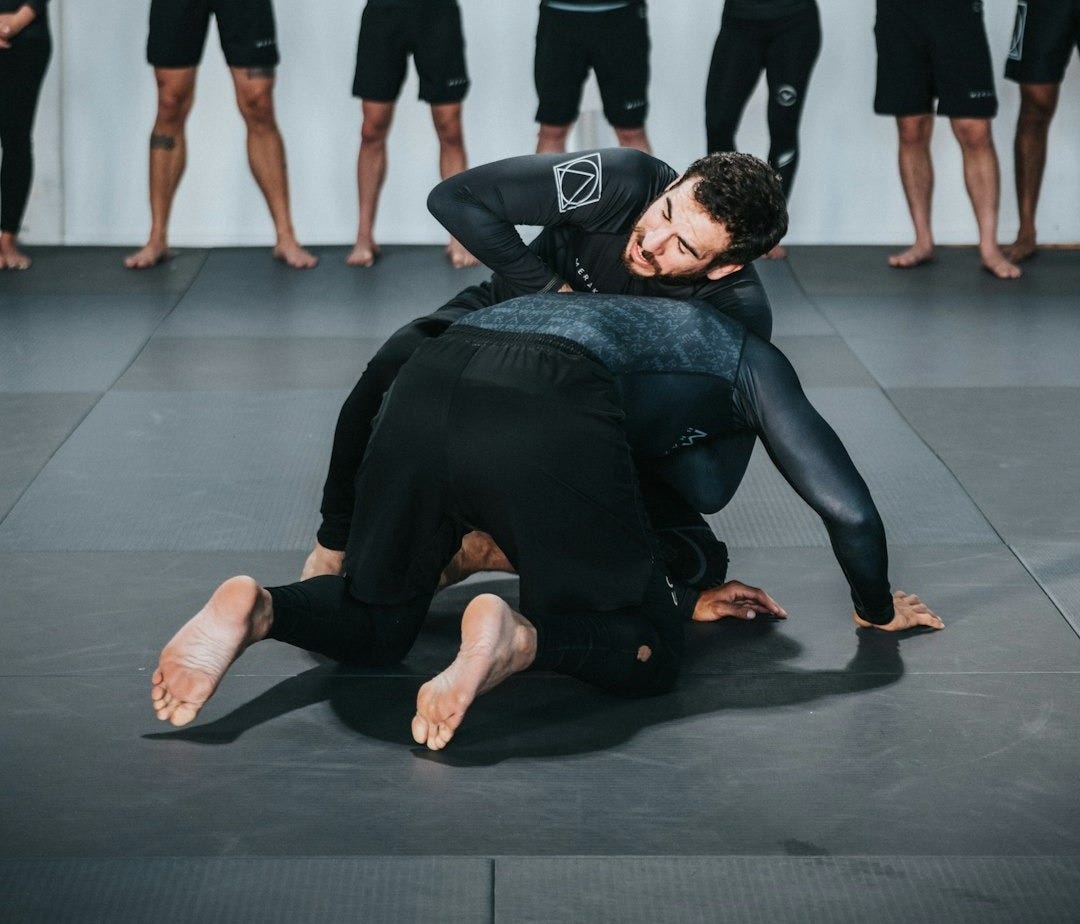
These changes are still a little startling to me, because in the past I found it very hard to make fitness changes stick. And I realized that if someone asked me how I’d done it, I would have to answer honestly: train jiu-jitsu two to three hours a day, five days a week; lift weights twice a week; and reorient your nutrition toward athletic performance rather than “regular eating.” Then sustain that for a year or more.
Which is funny, because I’m sure that sounds laughably obvious. It’s the opposite of a life hack. Tips and tricks are supposed to take something hard and make it easy. They create that little “wow” moment—I can’t believe you got those results by doing just this one small thing. Like if it turned out I’d improved my fitness simply by switching one meal a day to lemon Jell-O. Incredible. Anyone could do it.
But in my case, I took something hard and—somewhat unintentionally—tackled it with enough intensity that there simply wasn’t a way things wouldn’t shift over time. If I describe it out loud, it sounds obvious to the point of being almost embarrassing. If someone asked me how I changed my fitness and I answered honestly, they’d probably say, “Well yeah, obviously that would work.” Thirteen to eighteen hours of high-intensity exercise and/or targeted physical preparation per week is not a fitness hack.
Which got me thinking.
There is probably something you want to see change in your life or your business. What if you approached it in a way that, 18 months from now, when you got exactly the results you wanted, your approach would feel like a laughably obvious outcome of the work you put in? What if you did the thing that would make someone say, “Well yeah, obviously that would work.”
Naomi Dunford of Itty Biz has a framework that captures this from a different angle. She asks: for the goal you have, what would it look like to try really hard? And she clarifies that trying only counts if it happens “in the place in time and space where the trying makes a difference… You have to be able to replay the tape of the day and point to the footage of yourself actually doing the trying.”
I think that’s ultimately what worked for me with jiu-jitsu. Because I came to it backward—I hadn’t even intended to start—and because the fitness wasn’t about shrinking myself but about injury-proofing my body to do a sport I fell in love with, all of the effort went into actually doing the doing. Not planning. Not optimizing. Not feeling bad about falling short. Just showing up and training.
And if you’re not willing to do that for the thing you say you want—why? Is it because you don’t actually care enough about the outcome to put in that level of work? Is it because the work itself would make you miserable? Is it because you’re not willing or able to restructure other parts of your life to allow that intensity? Those are all completely valid answers. But if you’re pretty clear on what would be required to get the outcome you want—and you’re not willing or able to do that—why are you still holding onto the goal?
It’s true that sometimes the right approach is small steps. Sometimes “just the next right thing” or the tiniest possible movement forward is exactly what’s needed. I’m generally moderate in all things. Especially in a culture that glorifies hustle and endless escalation. Especially when burnout is real, when many of us are caring for other people, dealing with physical limitations or chronic illness, and trying to pay the bills.
But I’m not actually advocating for doing more. I’m advocating for doing what’s required—if the thing truly matters. And if it doesn’t matter enough to do what’s required, why is it taking up space in our already limited hearts, minds, and schedules?
I also think there’s a kind of freedom that comes from not holding back. I remember being on the high school basketball team and finding practices absolutely exhausting. I tried to conserve energy, to find the easier path through them. But I eventually noticed that looking for ways to hold back took more effort than just showing up and throwing my full energy, attention, and physical effort into the two hours of practice. Somehow, it was easier to really try than to half-try.
Poet David Whyte points at something similar when he writes, “The antidote to exhaustion is not necessarily rest. The antidote to exhaustion is wholeheartedness.” I think our emphasis on boundaries, self-care, moderation, and pacing is deeply important. But sometimes what actually drains us is not effort—it’s the friction of holding back, of wanting something while never fully committing to the work that would make it real.
So here’s a suggestion. For the thing you most want to shift in your life or business, what would obviously work, if you actually tackled it that way? You don’t have to do it. Just imagine it. And then imagine how it would feel to move through your days with that level of commitment. Would it feel exhausting—or would it feel oddly clarifying? Even relieving?
Either way, I think you deserve the wholeheartedness of choosing. Of setting down the half-measures, even if that means setting down the goal altogether.