
What We Learned from Hey Neighbor's $3,000 Debut
4 cooks from 3 countries making food for 65 enthusiastic local customers... and some big lessons learned.

Four entrepreneurs from three countries, 65 families served, $3,000 in direct revenue to local cooks, and 605 individual items prepared—all in one day.
This past Monday marked the successful launch of Hey Neighbor: takeout from local cooks with global roots. Customers were able to order meals—from Oaxacan tamales and Salvadoran pupusas and sandwiches to Colombian empanadas— and pick them up hot and ready (or frozen to heat up later).
Below, I’m sharing our reflection process of what we set out to achieve with Hey Neighbor, what we’ve learned so far, and what might happen next.
The Intentions of Hey Neighbor
Our goal with Hey Neighbor was to better support people starting food businesses while connecting these entrepreneurs with their surrounding communities. The name "Hey Neighbor" reflects our core belief: dynamic, vibrant entrepreneurs are launching businesses all around us, and they need only modest support to truly thrive and contribute meaningfully to their neighborhoods. Meanwhile, community members want to be part of that entrepreneurial journey—to benefit from and contribute to the process. Hey Neighbor creates a simple way to bring these groups together, fostering connections that embody the spirit of saying "Hey Neighbor."
These are the needs we identified on both sides…
People who are in the earliest stages of starting food businesses need:
A clear sales “case” for business development. Many are more likely to take essential steps—getting insurance, refining menus, setting pricing, starting bookkeeping—when these connect to concrete sales opportunities with defined requirements and support. One advisor of mine calls this “derisking” these steps — essentially lowering the risk of this investment of time, money, and focus by connecting it directly to revenue.
Support with regulatory requirements. With any food business, permits, insurance, and the need for a commercial kitchen can become large barriers especially when you add challenges with language, technology, immigration status, etc.
Access to new customers. Folks struggle to reach markets beyond their immediate social networks (for reasons of language, marketing experience, and others.)
At the same time, we notice that many consumers want to:
Discover new foods and flavors.
Support new entrepreneurs, perhaps especially immigrant entrepreneurs.
Have an easy way to “deal with dinner and skip the dishes.”
Hey Neighbor was designed as a structured, supported sales platform that addressed these challenges and opportunities simultaneously. The Food Academy served as the entry point to Hey Neighbor. Over 30 days, we helped participating entrepreneurs refine their recipes, streamline production processes, navigate regulations, develop professional packaging, and explore sustainable business models. Together, the Food Academy and Hey Neighbor provided entrepreneurs with both practical skills and immediate sales channels. On the consumer side, we carefully balanced the menu between exciting new offerings and familiar favorites, while making the promotion and ordering process as intuitive as possible.
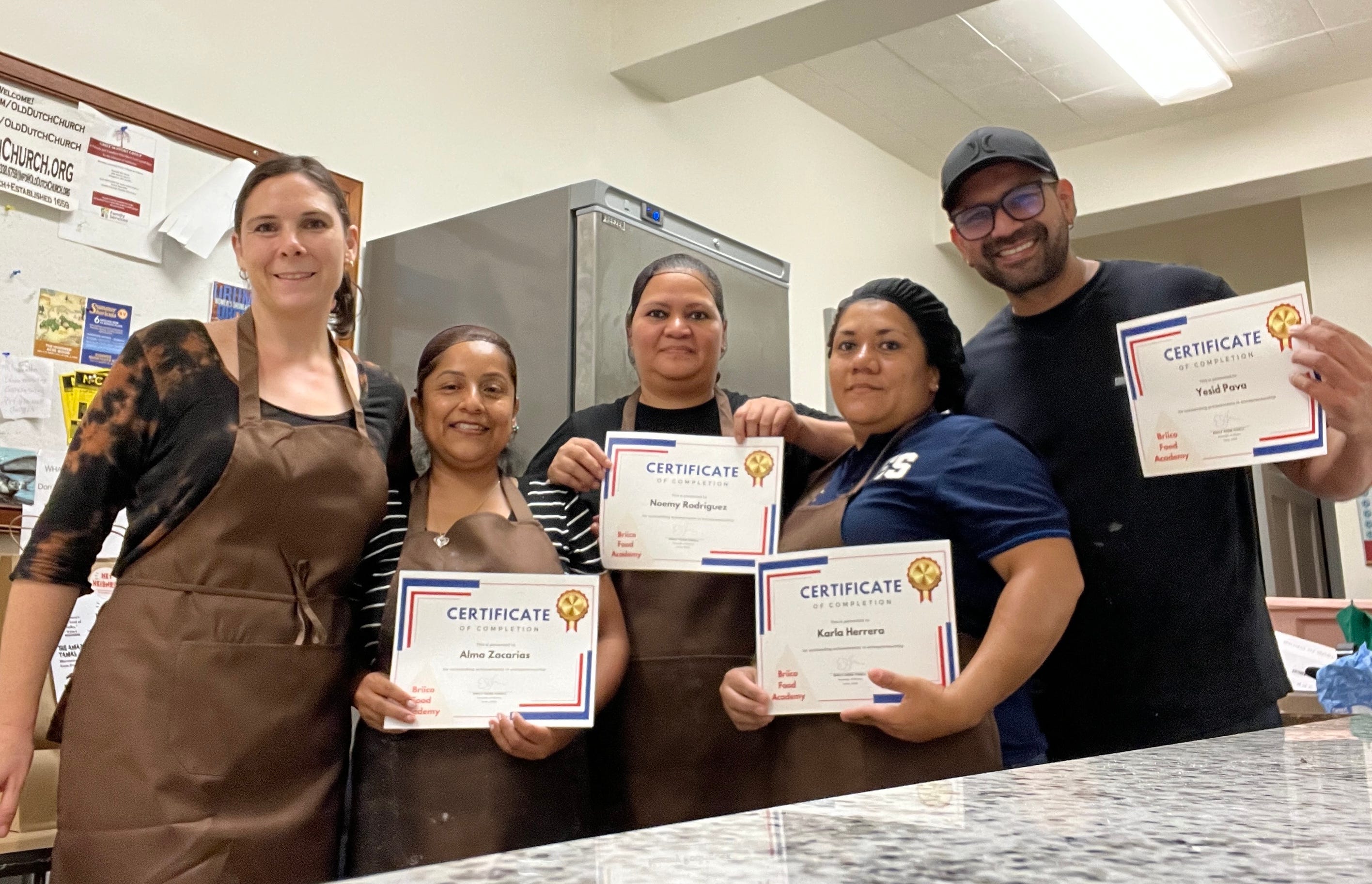
The cooks of Hey Neighbor (plus Emily) with their Food Academy completion certificates.
What It Took to Make It Happen
In some ways, Hey Neighbor is a simple idea. But of course, the rubber meets the road in details — and there were a lot of them!
In the weeks leading up to the event, the cooks — Yesid, Alma, Noemy, and Karla — worked hard on menu development, sourcing, and promotion.
Briico’s tiny team also worked full-time on the project:
Doing intensive promotion including flyering, outreach to more than 100 organizations and individuals, social media, and more.
Meeting regulatory requirements, filing paperwork, getting insurance, etc.
Working in person with entrepreneurs to help them develop their products, pricing, and packaging.
Securing a commercial kitchen that would meet our needs.
Architecting the operations for both the food production and pickup.
Creating and sourcing packaging and collateral.
Providing end-to-end day-of support (it ended up being a team of 3 people present to support the entrepreneurs 8am-8pm with food prep, order dispatch, cleaning, and organization.)
This time around, Briico paid for the hard costs and staff time of Hey Neighbor — all food revenue went directly to the cooks, based on what they had sold.
Hard costs (printing, packaging, fees, etc) totaled $591. Staff costs (one month of one person working full-time and one person working part-time) would of course multiply that several-fold.
Marketing and promotion was of course a really important part of what our team contributed… here’s a peek inside that marketing effort:


What Happened
On July 21st, 2025, Hey Neighbor delivered remarkable results in its debut event. Four entrepreneurs from three countries—Karla, Alma, Yesid, and Noemy—generated $3,000 in direct revenue while serving 65 families across the community. This meant each cook averaged $750 in sales (for 1-1.5 days of work), while collectively preparing 605 individual tamales, pupusas, empanadas, and other items in a single day.
Obviously, the success of the event was due to the focus, professionalism, creativity, and optimistic outlooks of the cooks. At every turn, the cooks demonstrated what true entrepreneurship looks like: thoughtful planning and strategic purchasing, seamless collaboration in a shared kitchen space, graceful adaptation when timing shifted and logistics changed, and remarkable resilience juggling childcare responsibilities alongside the demands of a marathon cooking day. They maintained their professionalism and positive energy through every challenge, cleaned meticulously as they worked, and supported each other without a hint of drama or competition. Their ability to execute at such a high level while navigating the inevitable complexities of a first-time event speaks to both their individual capabilities and their collaborative spirit—qualities that will undoubtedly serve them well as their businesses continue to grow.
The event also represented the successful culmination of the 30-day Food Academy, transforming participating entrepreneurs from program graduates into active business owners with proven market demand and immediate revenue. But the $3,000 generated that day represents just the beginning—the business development skills, regulatory knowledge, packaging expertise, and customer base each entrepreneur gained through the process positions them to generate potentially tens of thousands of dollars annually for decades to come.


Evaluating Success: Impact vs. Sustainability
By nonprofit standards, Hey Neighbor was successful. With hard costs of just $591, we generated $3,000 in direct revenue for entrepreneurs—a 5:1 return on investment before considering the substantive business development impact on four emerging food entrepreneurs.
However, as we consider Hey Neighbor's future, we're weighing two critical perspectives. From a grant-funded nonprofit lens, these results justify continued investment and expansion. The combination of immediate revenue generation, business skill development, and community building delivered measurable impact at a reasonable cost.
From a sustainability and scalability perspective, the intensive staffing requirements and logistical complexity raise important questions. While the current model works well for periodic, grant-supported events, our goal is to create systems that can serve many more entrepreneurs with decreasing marginal costs—ultimately becoming self-sustaining or even revenue-positive.
What we learned
The core concept and format proved highly successful, demonstrating strong demand, significant business development impact on entrepreneurs, and meaningful community engagement.
Sales exceeded everyone's expectations, proving market demand on both the producer and consumer sides
The participating cooks were exceptionally positive about the experience - more so than previous Briico Business Program graduates - expressing pride in their accomplishments, satisfaction with revenue, and strong collaborative spirit
Entrepreneurs achieved significant business development milestones in preparation for the event, including understanding insurance, developing new products, refining pricing strategies, exploring promotional opportunities, and navigating regulatory requirements.
Customers responded with enthusiasm, patience, and encouragement, praising the food quality and supporting the community initiative.
The partnership with Old Dutch Church operated seamlessly, providing an ideal venue and collaborative relationship.
The event successfully demonstrated the viability of knitting together community while providing concrete revenue and business development benefits to local food entrepreneurs.
The event required significantly more preparation time, staffing, and logistical coordination than anticipated, making it difficult to deliver quality service while maintaining reasonable economics.
We underestimated food preparation time, starting at 8am for 4pm-6pm pickups when we should have started at 5am or split preparation across two days (frozen items prepared the day before).
The combination of hot food and ready-to-freeze items created complex operational challenges, with hot food requiring precise timing for cooking, packaging, and dispatch.
It demanded staffing levels that could undermine the project's economics. Even with me, my husband and niece helping the entire day, we struggled to maintain adequate service. Ideally, each cook would have needed a dedicated assistant, plus we required a full-day logistics manager and additional pickup staff - creating labor costs that would be difficult to justify against the revenue generated.
Cooking fell 1-3 hours behind schedule, making pickup more chaotic than ideal with customers waiting long periods, some having to return for missing items, and food not going out as hot as intended.
What Is Next
So the question is… where do we go from here? Specifically, is there a way to:
Change the offering and/or the operations so that the time/money "loss" of each event is minimal (or, ideally, net positive)?
Use the structure of the event for many more cooks without the logistical complexity multiplying proportionally?
Build toward a model that doesn't require my full-time attention to execute (and can thus exist alongside other important aspects of Briico’s work)?
Hey Neighbor proved it can deliver immediate, measurable impact while building foundations for long-term economic development. The challenge ahead isn't whether this model works but whether we can redesign the operations and offerings to serve more entrepreneurs without compromising quality or sustainability. The staffing intensity and logistical complexity we experienced may require fundamental changes to how we structure future events, potentially reimagining everything from the menu to the pickup process. The success, determination, and professionalism of Karla, Alma, Yesid, and Noemy shows us what's possible—now we need to determine how to make it replicable and sustainable.